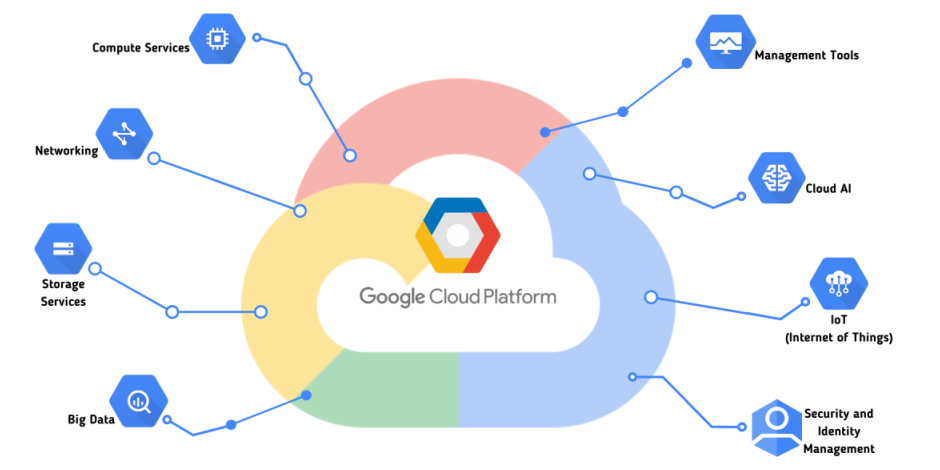
Google Cloud Platform Services You Should Know About in 2026:
- Google Compute Engine (GCE)
- Google Cloud Storage
- Cloud SQL
- Cloud Functions
- Cloud CDN
- Firestore
- Pub/Sub
- Cloud Load Balancing
- BigQuery
- Virtual Private Cloud (VPC)
Google Compute Engine provides scalable virtual machines running in Google's global infrastructure. It allows businesses to deploy applications quickly with flexible computing resources.
Examples: Snapchat uses Google Cloud infrastructure for handling millions of users. Spotify leverages Compute Engine for data processing and backend services.
Google Cloud Storage is a highly scalable object storage service designed for backup, archival, content delivery, and big data workloads.
Examples: Evernote stores large volumes of user-generated content in Cloud Storage. Media companies use it to distribute videos and digital assets worldwide.
Cloud SQL is a fully managed relational database service supporting MySQL, PostgreSQL, and SQL Server. It automates backups, updates, and scaling.
Examples: Many startups use Cloud SQL to manage application databases without maintaining database infrastructure.
Cloud Functions is Google's serverless execution environment that allows developers to run code in response to events without managing servers.
Examples: Retail companies use Cloud Functions for real-time inventory updates. E-commerce platforms automate order processing workflows using serverless functions.
Cloud CDN accelerates content delivery through Google's globally distributed edge network, reducing latency and improving user experiences.
Examples: Online streaming services and gaming companies use Cloud CDN to deliver content quickly across continents.
Firestore is a flexible, scalable NoSQL document database designed for web, mobile, and server development with real-time synchronization.
Examples: Mobile applications frequently use Firestore for chat systems, user profiles, and live data synchronization.
Google Cloud Pub/Sub is a real-time messaging service that enables asynchronous communication between independent applications and microservices.
Examples: Financial organizations use Pub/Sub for transaction processing and event-driven architectures. IoT platforms use it to process sensor data streams.
Cloud Load Balancing distributes traffic across multiple backend resources, ensuring reliability, high availability, and scalability.
Examples: Global web applications use Cloud Load Balancing to serve millions of requests while maintaining performance.
BigQuery is Google's fully managed, serverless data warehouse designed for large-scale analytics using SQL.
Examples: Twitter and The Home Depot have used BigQuery for analyzing large datasets and generating business insights.
Google Cloud VPC provides secure and isolated networking environments for cloud resources, allowing organizations to control traffic and security policies.
Examples: Enterprises use VPC to securely connect applications, databases, and hybrid cloud environments.